


Weekly Market Insights, Friday Oct 30, 2026
The report provides a weekly overview of Kenya's and global financial markets, focusing on bond trading, interest rates, inflation, equities, Eurobonds and emerging investment opportunities.
Market Overview
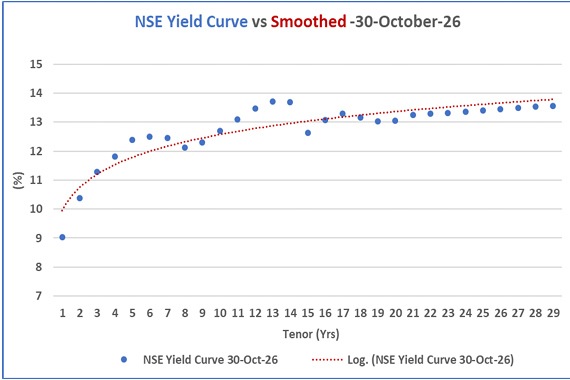
NSE Yield Curve vs Smooth-30-October-26
The NSE yield curve remains elevated in the short term for the papers below 6 years, with mixed up and down reactions in the medium term 7 to 17 years and stabilizes in the long-term end.
The rates remain shaky amidst inflation pressure, global trends and geopolitical tension
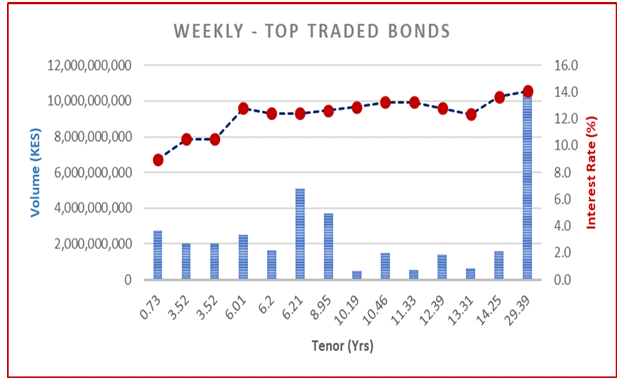
Graph of weekly-top traded bonds
During the week, demand was highly concentrated on the long-term end with FXD1/2026/030 trading at a volume of approximately 10 Billion.
This presents an investment opportunity on the long-ended bonds and may appeal to pension funds and other institutional investors seeking long-term income streams.
Interest Rate Outlook
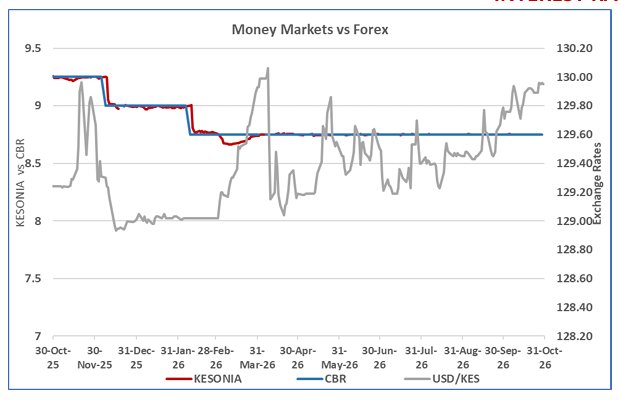
Graph of Money Markets vs Forex
Money Market Trends
The Kenya Shilling remained stable against major international currencies for the past weeks amidst the wars, with no aggressive fluctuations, most specifically against the US dollar.
On average the Kenyan Currency against the USD exchanged at KES 129.90 over the week.
KESONIA rate remained unchanged at 8.75% on average over the week ending 30th October 2026.
This week the Monetary Policy Committee maintained the CBR rates at 8.75 % for a forth consecutive series.
The money market remained liquid during the week ending 30th October 2026 with open market operations remaining active.
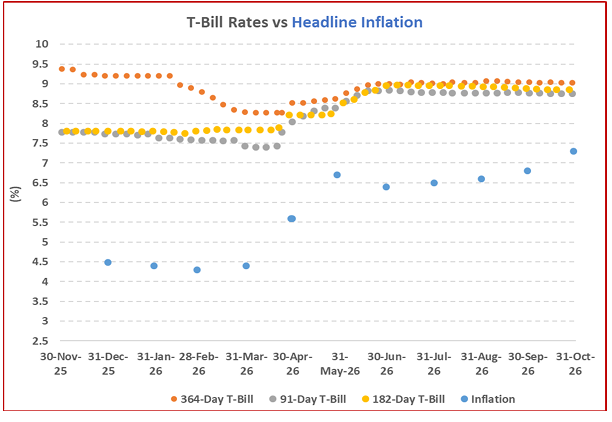
T-Bill Rates vs Headline Inflation
Short End of the Yield Curve and Inflation Trends
The Kenyan inflation marginally edged upwards in the month of October to 7.3% compared to 6.8% in September. Food, transport and Fuel inflations accelerated to 10.2%, 17.1% and 3.7% respectively.
This week marked the thirteenth consecutive oversubscription of T-bill, with a total subscription rate of 185.2%, up from 103.0% the previous week.
The 91-day paper was particularly favored, attracting bids of Kes 40.6 billion against Kes 8.0 billion offered, resulting in a subscription rate of 507.9%, significantly higher than last week's 179.2%.
In contrast, the subscription rates for the 182-day and 364-day papers declined to 53.2% and 59.1%, respectively.
The government accepted Kes 51.7 billion of the Kes 51.9 billion bid total, yielding an acceptance rate of 99.7%.
KENYA SECONDARY BOND MARKET TRENDS
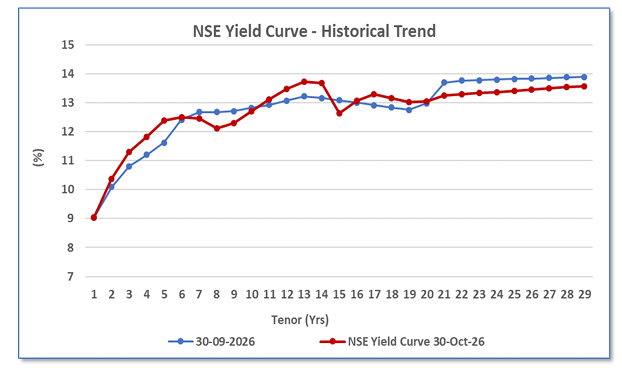
NSE Yield Curve - Historical Trend
The NSE yield curve remains elevated in the short term for the papers below 7 years, with mixed up and down reactions in the medium term 8 to 17 years and edges downwards in the long term end.
The rates remain shaky with impulse fluctuation and shifts influenced by the global and local inflation, geopolitical conflict and future inflation forecasts.
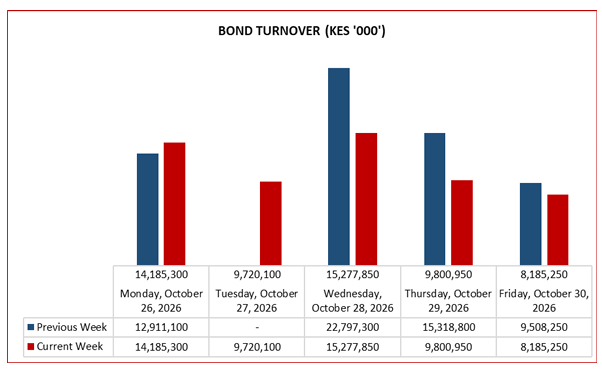
Bond turnover
Week-on-week traded volumes shows robust performance across the two weeks period with turnover shifting within the week.
The turnover edged downwards over the week with a margin of 5.60% for the week ended 30th October 2026 compared to the previous week.
The turnover closed at 57.20 Billion down from 60.54 Billion in the previous week.
KENYA PRIMARY BOND MARKET
Reopened Bonds
Treasury Bond Auction
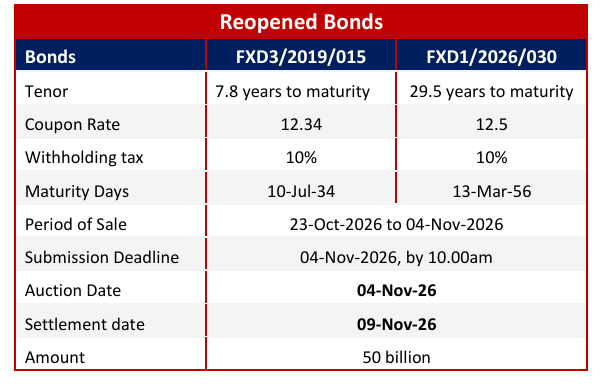
CBK has initiated a Kes 50Bn auction for November, featuring reopened 15-year and 30-year fixed-coupon T. bonds aimed at budgetary support.
The bonds include FXD3/2019/015, with a 12.3400% coupon and maturity on 10 Jul 2034, and FXD1/2026/030, with a 12.5000% coupon maturing on 13 Mar 2056.
The bid deadline is 4 Nov 2026 at 10:00 a.m., with the auction scheduled for the same day and settlement on 9 Nov 2026.
This offer brings the total conventional bond sales for FY2026/27 to Kes 530Bn, with completed auctions thus far generating Kes 536.24Bn in net bond borrowing.
INTERNATIONAL BOND MARKETS
USA: Treasury yields eased following the Federal Reserve's decision to maintain interest rates. Equities recorded modest weekly gains despite technology-sector weakness and concerns over AI spending.
UK: Gilt yields remained elevated amid inflation and interest-rate concerns, while the FTSE 100 recorded modest gains.
Germany: Bund yields eased slightly following the ECB's rate decision, while equities advanced on improved investor sentiment.
Japan: Government bond yields remained relatively stable as the Bank of Japan maintained its policy rate. Equities were volatile, with technology stocks facing selling pressure.
China: Bond yields remained low amid subdued economic growth and supportive monetary policy, while equities weakened amid concerns over economic recovery and technology stocks.
KENYA EUROBOND MARKET
Eurobond Yields
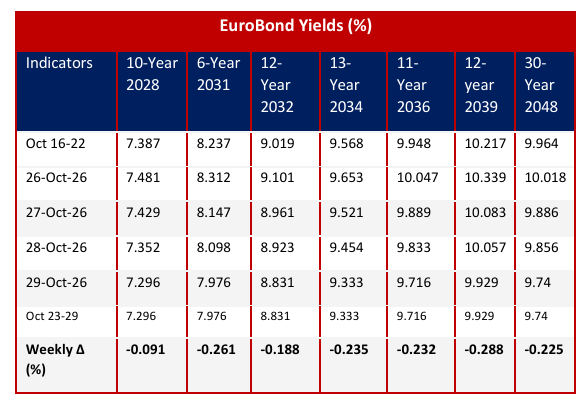
Yields on Kenya’s Eurobonds fell over the week indicating reduced appetite influenced by the shaky rates due to the rising tensions and the global inflation compared to the previous week.
On average, yields fell by 22.07 basis points. This suggests some downward price movement or imbalanced state by investors in relation to global market conditions amidst geopolitical pressures.
In attachment, is the performance of the Daily Eurobond turnover for the week ended 30th October 2026 in statistical way.
KENYA EQUITY MARKET
Equity Market
Equity Market Highlights
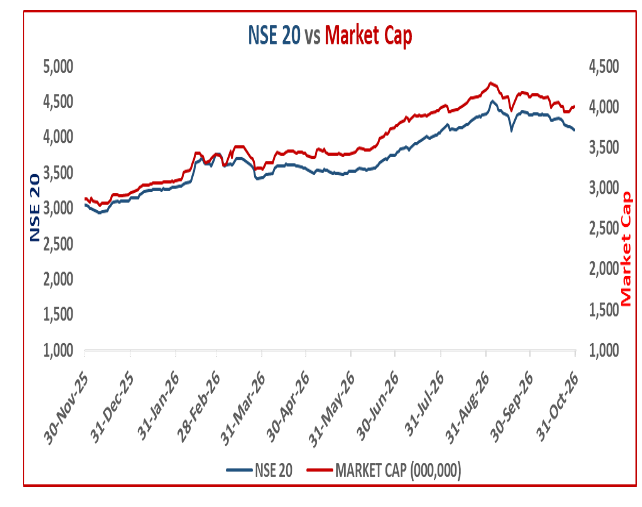
At the Nairobi Securities Exchange, the NASI, NSE 25 and NSE 20 experienced mixed reactions in the trading activities with +1.38%, -1.24% and -1.89% respectively during the week ended 30th October 2026.
Market capitalization, edged upwards by 1.4% closing at 3.99 Trillion.
NASI, NSE 25 and NSE 20 Indexes closed at 238.16, 6556.73 and 4098.26 respectively.
Weekly Top mover was Kenya Pipeline Company adding over US 1 billion in market value in Seven-day rally following Dangote’s 25% stake acquisition.
Global Trends
Global Monetary Policy
During the week, the Bank of Canada raised its policy rate by 25 basis points in response to persistent inflationary pressures.
Meanwhile, the US Federal Reserve, European Central Bank, Bank of Japan and Reserve Bank of New Zealand maintained their policy rates unchanged as they assessed prevailing economic conditions.
The US Dollar Index strengthened by 0.22%, reflecting movements in international currency markets and investor expectations regarding future US monetary policy.
Economic Development
Global economic developments during the week reflected continued uncertainty in the global economy, particularly regarding inflation, monetary policy and geopolitical tensions.
The increase in oil prices could contribute to higher global inflation, while expectations of tighter monetary policy in the United States may influence international investment flows and exchange rate movements.
For developing economies such as Kenya, these developments are particularly important because the country relies heavily on imported petroleum products.
Higher international oil prices, combined with possible strengthening of the US dollar, could increase the cost of imports, put pressure on the Kenyan shilling and contribute to higher domestic inflation.
Oil and gold prices
Murban crude oil prices increased by 2.06% to USD 110.46 per barrel on 30 October 2026, from USD 108.23 per barrel on 23 October. The increase was mainly driven by geopolitical tensions and concerns over potential global oil supply disruptions. Higher oil prices could increase import costs and domestic inflationary pressures in oil-importing countries such as Kenya.
Spot gold prices declined marginally by 0.09% to USD 4,020.40 per ounce on 30 October 2026, from USD 4,023.90 per ounce on 22 October. The decline was mainly attributed to expectations of a possible US Federal Reserve interest rate increase in December, which could make interest-bearing investments more attractive than gold.